
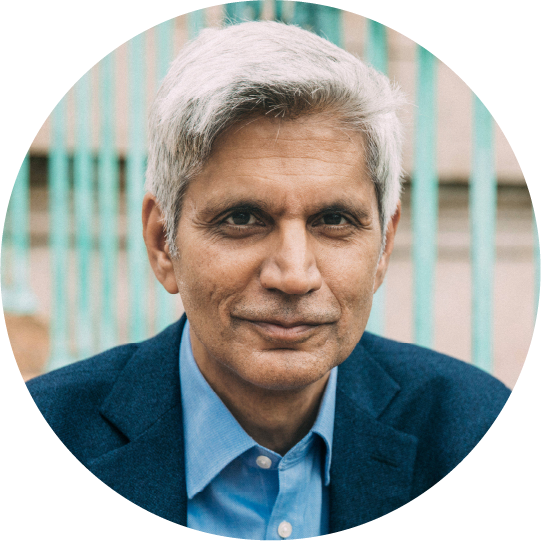
I’m delighted to share this article on Leading in the Flow of Work I just published as the cover-feature in Harvard Business Review.
The article lays out an approach for how we can accelerate performance breakthroughs in our work, and in our lives. It pushes the boundaries on what experts have claimed you are capable of doing, with regard to your personality, your leadership competencies, and your ability to get breakthroughs in challenging and high-stakes situations.
My team and I have worked on this approach for the last 15 years. It has borne, and continues to bear, great fruits for a number of professionals, and with the publication of this article, we’re happy now to share it more broadly with the world.
Over the next few weeks, I will, in this newsletter, be offering stories and commentary on leading in the flow of work, to offer deeper dives on what we’ve learned. For today, I want to share an inside story about one of the key shifts the article invites us to take on — to approach exemplary leadership as a state, not a trait.
Connecting With a Living Legend: Try Again. Fail Again. Fail Better.
Fifteen years ago, I discovered the remarkable work of Dr. David Burns from Stanford University, a pioneer in the field of cognitive-behavior therapy (CBT).
David worked with Dr. Aaron Beck at UPenn, the co-founder of CBT (along with Dr. Albert Ellis), in formulating the key building blocks of this field of therapy. David’s beautifully written books, like Feeling Good: The New Mood Therapy, have sold over 4 million copies, and he has trained over 10,000 therapists in his career in the practice of CBT. This field has become the most broadly embraced and successful treatment for mental health issues in the last 35 years. David is a living legend in the world of psychotherapy.
I wanted to meet David, to learn from him and partner with him in bringing his methods to the business world. I wrote to him, and I called him up at Stanford, but didn’t get a response. So I waited until he was scheduled to do a therapist training workshop in a suburb of Washington DC. I took the train down from New York and then a cab to the hotel where he was doing his workshop, arriving a half-hour before he was scheduled to wrap up.
“Oh, dear, I am so sorry!”, exclaimed the hotel receptionist when I told him I was there to meet David. “Dr. Burns wrapped up the workshop an hour early today. So he dashed off to the airport to get an earlier flight back to San Francisco.”
Oh, no! That evening, a forlorn Hitendra returned to New York with nothing to report.
A few months later, I decided, “Don’t just seek to stalk him outside his workshop. Participate in his workshop.”
This would be quite a renegade act. Dr. Burns’ workshops were meant for psychotherapists, not business professors. There were psychotherapy degree prerequisites you were meant to meet. But I took the plunge, flew to St. Louis for one of his weekend workshops, and cajoled the organizers to allow me to attend. Ah, a small victory! A sighting of David was now surely just moments away!
But the morning of the workshop, David is nowhere to be found. We are all in attendance, waiting.
“Will he elude me yet again?” I wonder.
An hour into the program, he shows up. I quietly exult.
“I was to fly here to St. Louis last night, but the flight was canceled after we waited on the tarmac, because of bad weather. Then I was on an early morning flight today, and that too got delayed, which is why I wasn’t here earlier today.
“But you have no idea how grateful I feel to be here now. Because in the baggage claim, mine was the first bag that arrived on the belt! Can you believe that? I could have been much more late, but the universe was so kind to me. Thank you for your patience, and we’re going to make up for it by having a really good time these next two days.”
It was, as I later discovered, vintage David. Having an inner conversation with our souls, subtly shifting the somewhat strained energy in the room into a positive, grateful, anticipatory state.
A whole new world opened up to me that weekend. The hundred-odd therapists who came to learn from him in St. Louis took me graciously under their wings, as did he.
From Minimizing Pain to Maximizing Gain
That first meeting was the start of a very rewarding partnership with David. Over the years, we’ve collaborated in building mental health training materials and in extending his work into what I see as the very complementary world of leadership training. I’ve learned so much from dialoguing with David and by observing him as a codifier, teacher, coach, and human being.
A key insight from David’s work is that for someone who is diagnosed with depression, generalized anxiety disorder, or another mental malady, it is best for them to view their situation as a state, not a trait. This is one of the fundamental principles of CBT — that most people (perhaps not all, but certainly most) struggling with a mood issue are only temporarily in a state of depression, anxiety, anger, etc. Recognizing that our moods are not rigid or defining aspects of our identity leads us to a breakthrough — we open ourselves up to the possibility that, at any moment now, under the right conditions, and with the right intention, we can move from being deeply sad to intensely happy.
In fact, I have sat and observed patients who come for a therapy session to David. Starting from a place where they are sad, hopeless, anxious, defeated, even crying or having a panic attack, David guides them toward certain shifts in thought and behavior and this same individual, within a half hour, is giggly, positive, confident, at peace — ready to take on the world.
This comes as a revelation to these individuals — the fact that they can move so rapidly from being in pain to being joyful. But the therapy session isn’t over yet. David now delivers his piece-de-resistance. Just as the patient is declaring victory over their mood, he warns them that they will in fact experience a relapse. Their negative thoughts and emotions will likely return to flood their mind at some point, because the habits of thought are likely deeply rooted. But now they have the CBT tools — and experiential proof! — that they can apply to reclaim their peace.
I’ve taken some of the tools and insights David has developed to minimize people’s pain and extended them to maximize people’s gain — i.e., boost their performance.
Approach High-Performance as a State, not a Trait.
CBT tells you that mental health in many cases is a state, not a trait — and one of the recent breakthroughs we’ve arrived at in my work at Columbia Business School and Mentora is that leadership performance is also best approached as a state, not a trait.
When we struggle to give effective feedback to someone, or to have a difficult conversation, gain an executive’s buy-in, resolve a conflict, or inspire a team, we have a choice. We can see this underperformance as evidence of a trait that is lacking — or as a state we simply weren’t able to activate in that situation. When we approach it as a trait, we run the risk of becoming lazy. We tell ourselves:
“This is just who I am!”
“Look, I failed again. I’m no good at ___”
“I don’t have time to develop this skill. I’m already so stretched at work!”
But when we approach it as a state, we can no longer give ourselves permission to stay ineffective. The state approach to high performance says: “I have much untapped potential in me. I owe it to myself and to my mission and my team, to activate this high-performance state in myself.” Your day-to-day attitude at work starts to shift. You no longer allow yourself to be on auto-pilot, acting and reacting based on your instinctive grasp of things. Instead, you strive to stay ever-mindful, ever-aspirational for breakthroughs as you ask yourself;
“What’s likely to happen at this meeting? What could happen, if I bring the right energy?”
“How should I show up, to have the greatest impact?”
“What intention, what behavior, what style, will best advance our goal?”
You then go on to tap your latent faculties and your repertoire of styles and behaviors to do what’s needed. And over time, this quality of being ever-mindful, ever-aspirational, ever-intentional becomes a habit. A state becomes a trait, part of who you are.
That’s exactly what we’ve designed LiFT to do for you.
Accelerating Performance for the Moments That Really Matter.
LiFT is Mentora’s new AI-powered performance coaching platform, being launched in February. It guides you toward the high-performance state you need for the emotionally charged or high-stakes challenges you face each week. It helps you be inspiring. Or persuasive, collaborative, empathetic, strong — whatever will help you bring out the best in the situation.
LiFT is based on the model I describe in the Harvard Business Review article — that you have 5 core energies within you, of Purpose, Wisdom, Growth, Love, and Self-realization, and that you can use 25 simple actions to activate these energies and create a high-performance state in your dealings with others.
You can go here to register for access to LiFT if you like. We’ll be launching it soon.
Warmly,
Hitendra
Like This Newsletter?
Share it with someone who might find it valuable.


Leave a Reply