
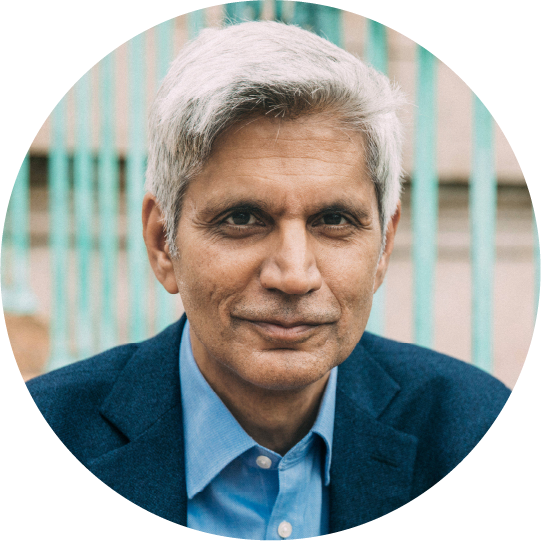
A story of a lesson I learned from two men, half a world apart.
There is a monk in India I have known for 45 years. He has been very dear to me, and I’ve been deeply inspired by the devotion and tireless spirit with which he has served the spiritual needs of all who have crossed his path.
It had been 15 years since I had last seen him, when, one day a few months ago, I learned he was in the same ashram I was briefly visiting during a trip to India. A young monk came and told me, “Hitendra, Swamiji is climbing up the stairs right now, to return to his room, in case you want to say hello before he retires for the day.”
I rushed toward the stairs, and was immediately taken aback at the sight of this dear mentor.
He had aged considerably over these fifteen years—he had lost significant weight, and he was climbing the stairs effortfully and slowly, with a very hunched back.
“Age has taken its toll,” I thought to myself, saddened by what I saw. “His body is a pale shadow of the dynamic energetic form I remember from past years.”
I should perhaps have anticipated this would be the case, for he was now close to ninety years.
The monk paused in his ascent up the stairs when he heard my voice. He straightened his back and turned around. It took him a few seconds to recognize me.
(After all, I suppose I too must have aged a bit these last 15 years.)
“Look at him, Hitendra, look at him!”, I thought to myself. “His body may be frail, but oh what a happy monk he is!”
He was beaming with a beatific smile, was giggling playfully (as he would often do), and his eyes—ah! his eyes—were dancing with a deep, peaceful, luminous joy.
“Nothing,” I told myself, relieved, “has truly changed at his core.”
We had a small, sweet reunion. We shared how each of us had been. I told him how dearly he was loved by me and so many, and how I had had him in my thoughts these last several years. He blessed me, then turned around to resume his slow climb to the floor above.
~
A few weeks later, I was in San Antonio, Texas. I pulled up my Uber app to order a car to take me to a resort where I was to be on a retreat. Uber assigned me a car driven by a man named Robbie.
The Uber arrived. I got into the car and we began our drive. Suddenly, in the rear view mirror, I saw Robbie and I instinctively winced from within.
How could Uber assign me this driver? Shouldn’t they have known? Why wasn’t this clear, from his photo in the Uber app?
My thoughts were racing.
And this isn’t even a short drive! It’s going to take a good 30 minutes to get to my destination. I’m going to have to bear with this for this long stretch of time.
I braced myself for the discomfort ahead. Robbie kept driving quietly.
Within a few minutes, something started to stir within me.
Hitendra, how can you? This is not right, the feelings you’ve just had for this man.
How can you judge? How can you look away?
So I looked at Robbie from the backseat, and we began a casual conversation, as you might have with any Uber driver. Sweet banter about life, the Spurs’ basketball game, and the state of the country.
Quietly, I also turned to my phone and made an inquiry about his condition. What kind of affliction did he have? What caused it, and how common was this in the world? Was there a cure?
Robbie’s face—and perhaps the rest of his body too—was covered by a profusion of tumors. I learned that he had an extreme form of a condition known as NF1. Most people with NF1 develop only a few such tumors; only rarely does the condition manifest as extensively as it did in Robbie.
An image flashed in my mind, from a few months ago. I had seen a woman with the same condition walking on the streets of Manhattan. In that case, I’d quickly turned my gaze away, to avoid having to see her face.
But this time, I was committed to redeeming myself. Fate had given me 30 minutes to do so.
“What if he was your son, Hitendra? Would you not in that case have felt a deep love for him? Why don’t you engage with him now with the same depth of feeling?”
My heart softened. My gaze became more steady. Our conversation deepened.
Quietly, I felt waves of love emanate from my heart to Robbie and to all in the world who had the same affliction.
When we arrived at our destination, he stepped out to help get my luggage from the trunk. In that moment, for the first time, he and I were face to face.
I will never forget what I experienced next.
Behind the disfigurement of his face, he was beaming with a beatific smile, giggling playfully, and his eyes—ah! his eyes—were dancing with a deep, peaceful, luminous joy.
“He is flowing,” I observed to myself, “with the same spirit that I had experienced in my moment with Swamiji.”
Robbie and I said our goodbyes. I thanked him, and as he drove away, I stood watching his car grow smaller in the distance, with the tenderness I might have felt watching my own child leave.
~
In these two fleeting encounters, my monk, who I have learned so much from in the last forty-five years, and Robbie, who I had only just met, taught me one of life’s most precious lessons.
That we should not confuse the form with the spirit that rests within.
Their forms were struggling, and not in small ways. One was carrying nine decades of tireless service in a body now bent and slow. The other was carrying an affliction that made strangers look away. Their physical forms were far from ideal, far from what we may call “normal.”
And this, in time, is the nature of every body—theirs, and ours. In some seasons, we walk in it with a feeling of healthful pride and youthful vigor, and in other seasons, it feels old, rugged, sick and struggling.
But what animates our form is our spirit, and people experience that on our face, hear that in our voice, and, most of all, peer into that in our eyes.
We do not have to wait for a form to be aged or ailing. Whenever we encounter someone face to face, or hear their voice, or look in the mirror at ourselves, life is inviting us to honor the form, and then to look past it to discover the deeper dance of the soul, ever-alive, ever-peaceful, ever-in-joy.
May your eyes, too, dance with joy,
Hitendra
PS: Some years ago, another man’s story taught the world this same lesson.
Vinicio Riva was born in a small village in northern Italy, carrying an extreme form of the same condition Robbie lives with. “The first signs appeared after I was 15,” he once recalled. “They said I would be dead by 30. Instead, here I am.”
He never forgot the man on a crowded bus in Vicenza who told him to move away—he could not bear to look at him—while no one on the bus said a word in his defense. And yet Vinicio built a warm and affectionate life: friends to share pizza and football with, flowers for the nurses he liked to charm, quiet afternoons chatting with the elderly residents of the home where he worked.
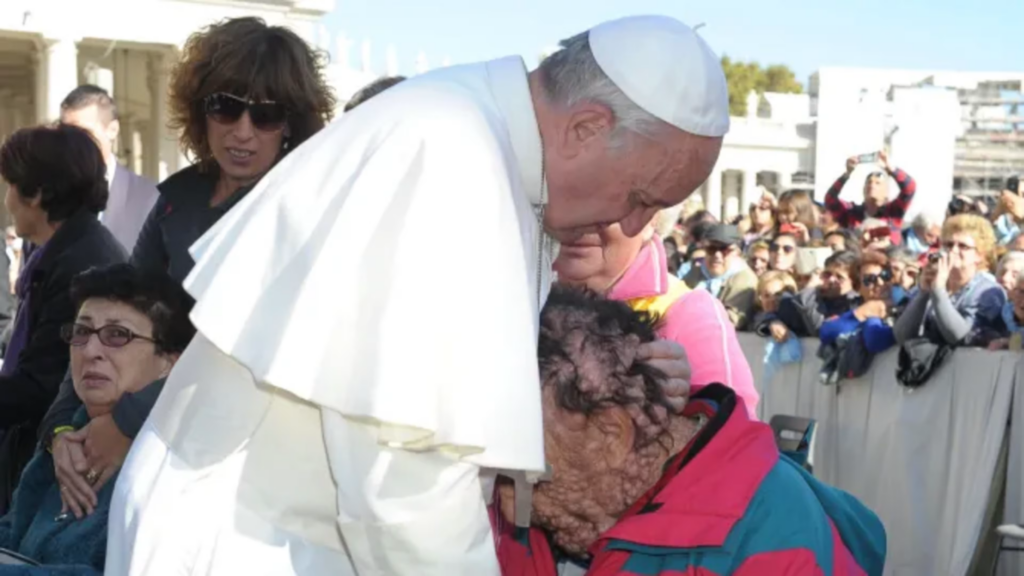
Then, in November 2013, on his first visit to St. Peter’s Square, Pope Francis walked over to his wheelchair, took his face in his hands, and held him—tightly, and for a long time.
“He did not think twice about whether to embrace me or not,” Vinicio marveled afterward. “I’m not contagious, but he did not know that. He caressed my face, and as he did, I felt only love.”
The embrace lasted little more than a minute, he said, but to him it seemed like forever. He felt, he later recalled, “like being in paradise.”
He then returned to the same house, the same job, the same struggling body. But as he turned away that day, he whispered to his aunt: “Here I leave my pain.”
And I have to introduce you to one more soul: Margaret Soars.
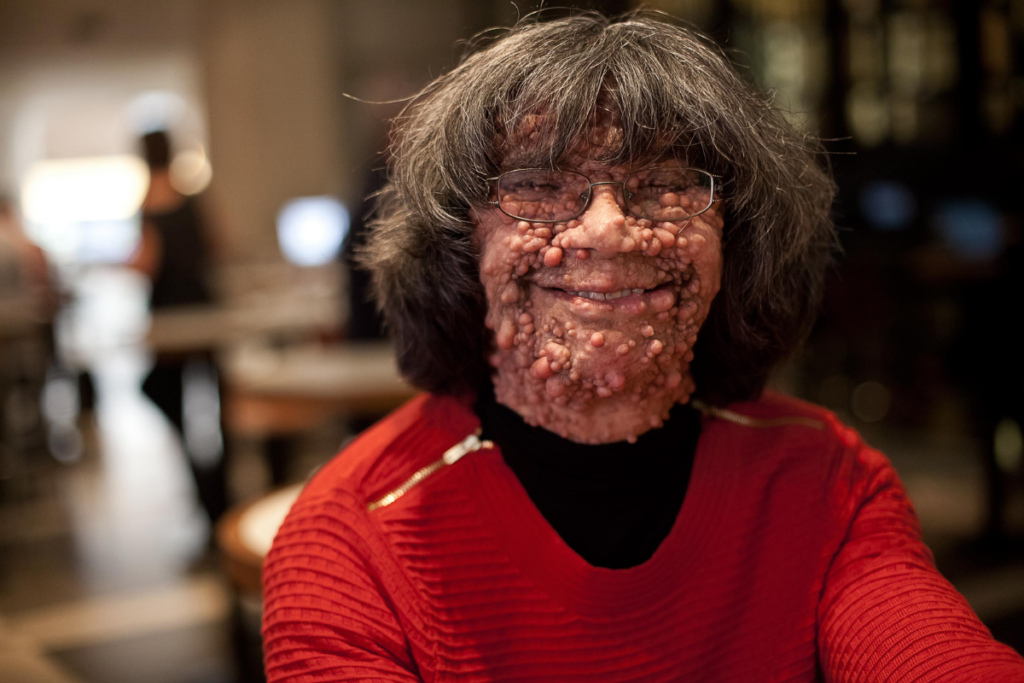
Margaret has had a 36-year career at the British Library, and a lifelong connection with the same condition Vinicio and Robbie carry.
“By this time I was in my early 40s,” she has reflected, “my husband had stood by as the NF took revenge by climbing up my face. I was finding that I was getting more comments that were difficult to deal with…so I turned to [the UK charity] Changing Faces who gave me guidance in how to deal with these situations. Two things I do: smile in the face of adversity, and count to ten before reacting.”
She adds, “I have always tried to keep a positive outlook and try to encourage those newly diagnosed to do the same.”
Here is Margaret.
Like This Newsletter?
Share it with someone who might find it valuable.


Leave a Reply