
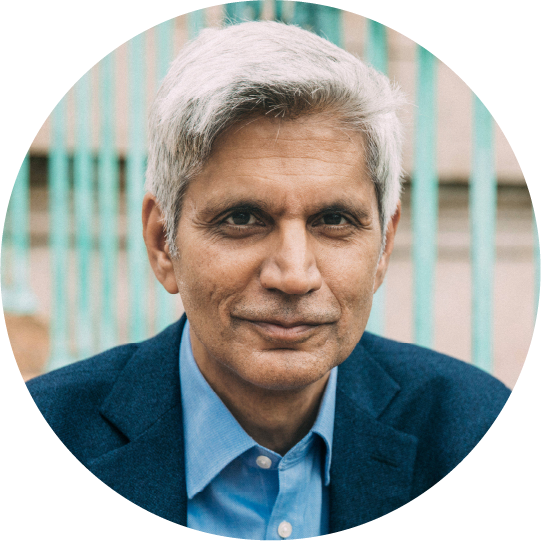
I write to you from the grounds of Davos, where two of my Mentora colleagues — Petra and Jake — have joined me for a week of interactions at the World Economic Forum with leaders from business, government, startups, academia, nonprofits, and media to disseminate ideas, build relationships, and engage in thought-exchanges on our evolving world.
In this newsletter, I want to share two conversations I had and what I learned from them.
A Paycheck with Purpose
Yaniv Vardi, the CEO of the Internet Security company Claroty, is a wonderfully inspiring entrepreneur. He is pouring his energies into growing a high-performing business that will, yes, bring great returns to its investors, but that, in addition, is here to do great good in the world, and be run as an efficient, accountable, aligned, and inspired organization. A great blend of yin and yang.
I loved this thought Yaniv shared with us on how he retains talent.
“People are key to my business, as they are to any business. I need great software developers. If you hire them by paying them well, that’s not going to work, because the next day, someone will offer them a better salary, and they are gone.
“Instead, I tell them, ‘Listen, 8 out of 10 hospitals in the US had a malware attack these last two years that brought their systems down for hours or days. Imagine what that is like, in a hospital. Surgeries are paused, machines stop working, treatments can’t be given. Lives are put at serious risk. That’s why we do what we do — as the world becomes increasingly fraught with risk based on the actions of certain bad digital actors, the world needs us to provide it security so we can stay safe.’
“Now if they choose to work here, they’re doing it for a clear purpose, a purpose that goes beyond making the biggest paycheck. Now I can have developers who stay.”
Not all of us are on fire to make the digital world more secure. To get more programmers motivated to take this on, Yaniv shows them how a technical topic like internet security translates into a very real and painful experience they identify with — disruptions in hospital services.
Sometimes, a person may have a personal purpose that blends with the organization’s purpose to drive their motivation. Jennifer shared her very personal story in my Executive-MBA class one day:
“Early in my career, I worked for a small company. One day, a senior executive at the office made a sexual overture at me. I was able to fend him off and stop him in his tracks. He looked at me and said, ‘You’re not going to share this with anyone tomorrow at work, right? Because if you do, it will be your word against mine, and who do you think they are going to believe?’
“I went home, shaken and seething. I wanted to report the incident, but I realized he was right. He had a strong standing in the organization, while I had only been here six months. They would most likely not give weight to my word against his. So I quietly warned other female colleagues about what I had experienced, started to apply for other jobs, and soon left the organization. After leaving, I lodged a complaint about him. Two years later, I was relieved to hear that he was forced out of the firm on more than one sexual harassment complaint.
“I later on reflected on how he had shattered my sense of security in that moment by intruding into a very sacred, private space. I decided this was the most important thing to me — to help protect peoples’ sense of security from wrongful intrusions. As an IT professional, I know how much risk there is for all of us today in the potential attacks we all face to our privacy and security. So I have decided to focus my career on IT Security, and this continues to give me great fulfillment.”
In a separate conversation with the CEO of a $500 billion investment fund, we discussed how for her, her CEO role and her organization are not her purpose.
“Really?” you might ask, “is she just working for the money?”
What I sensed in this CEO is a larger desire to evolve how leadership works in her organization and beyond, based on the capacities that she brings to it as a woman — she believes she can evolve the culture to practice greater empathy and intuition, to supplement the predominantly analytical ways in which they operate.
“For you,” I proposed, “your role and your company are not your purpose. They are the platform for your purpose.”
She smiled and nodded, with a sparkle in her eyes.
When your career is your platform, you still want to do your best and deliver your best and maximize financial and other measures of success. Because that will give you bigger opportunities to use this platform to advance your purpose.
How clear are you and your team members on the nobility of purpose that’s behind the work you all do, and how it connects with the organization’s goals?
Is your career your purpose, or the platform you use to express your purpose?
The Game CEOs Most Need Help With
In a fast-paced and wide-ranging exchange with Hernan Saenz, Senior Partner and Global Head of Performance Improvement at Bain & Company, he paused me at one point when I was sharing the different applications of Mentora’s AI-powered LiFT platform that we’re here at Davos to launch. He said to me:
“Hitendra, all this outer guidance it can give, around how a professional can influence people in their next meeting, or build trust, or give feedback, or…I get that. Sure. But tell me this. Most senior executives I interact with, and I myself, our biggest need is to get back to our center. When we get off-center in our emotions, we lose our high-performance state. When we are back in that centered state, we can do a lot of good things because we already know how to play that game well. So the most critical use case for senior executives of LiFT will be the inner game.”
I was struck by the humility and self-awareness Hernan brought to this moment. He could have claimed that he and the CEOs he advises have made it — that they get the game and what they need is to get their people to do their work well. Instead, he opened up the inner life of senior executives and the need to constantly monitor and regulate their emotional state. This resonates deeply with me, because the model we built in LiFT — leadership-in-flow — is grounded in a one-two punch approach: first shift your inner state toward a positive intention, then go and choose the right actions to maximize outer results in your dealings with others.
What do you first focus on to up your performance in high-stakes moments — your inner state or your outer behavior?
Warmly,
Hitendra
The global application deadline for Mentora LIFE is January 23, 2024. If you are drawn to what LIFE offers, I encourage you to apply — membership gives you the opportunity to build connection and community with like-minded truth-seekers, united in a shared quest for happiness, health, high performance, and harmony, and to tap Mentora’s rich arsenal of personal and professional growth tools — including our newest real-time coaching tool, LiFT, based on Generative AI — and our network of inspiring role models and experts.
Mentora LIFE is the culmination of a 16-year journey. I launched my class Personal Leadership & Success in 2007 at Columbia Business School. Over the years, it has yielded many precious learnings — a structured path to connect with one’s inner core, steps we can take to activate Purpose, Wisdom, Growth, Love, and Self-realization, an understanding of how to live a life of meaning and purpose, and guidance on how to pursue success in a balanced and authentic manner. I brought these learnings to the corporate world when I founded Mentora Institute, and now 10,000+ MBAs and executives later, my team and I have translated these learnings and experiences into a program for individuals who are seeking to live a life where the material equals the spiritual — a life where the material becomes our outer, expressive layer, and the spiritual becomes our inner, replenishing core. When we operate in this way, we bring two halves of a whole in sync with one another. We are able to direct our energies toward the pursuit of noble, uplifting causes. We build teams that are inspired from within to do beautiful work. We approach our relationships and all interactions — including moments of conflict — from a place of centeredness, respect, and appreciation. This is the foundation on which we have launched Mentora LIFE.
Like This Newsletter?
Share it with someone who might find it valuable.


Leave a Reply