
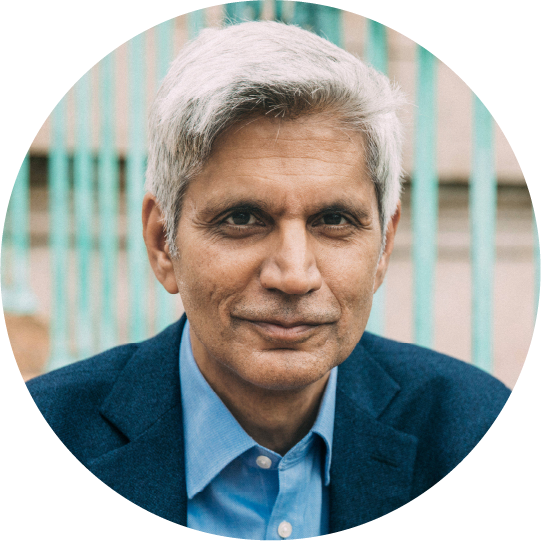
We live in an imperfect world. Some people are good, and others are bad. The heroes in our midst are the morally upright ones who strive to protect the good and fight the bad. That’s how a great society is built.
Father Gregory Boyle, a Jesuit priest, turns this conventional wisdom on its head.
“When we designate people as good or bad, it’s just the end of discussion,” he told me in a recent conversation with him I had on my Intersections podcast. “You no longer can be curious because you’ve already arrived at who’s good and who’s bad and I think it’s precisely what keeps us from making progress.”
“Judgment is where we always go, our default setting. Judgment is always trying to get in the room. Because curiosity and judgment can’t really coexist, you have to choose. As long as you stay curious, then judgment stays out in the hallway and it never gets into the room. Curiosity is asking the question — and then asking the next question.”
Father Boyle profoundly challenges our ways of thinking, and yet he speaks from a place far beyond the intellect. He speaks from 40 years of experience. But even more, he speaks from the depths of his soul, his eyes beaming with joyous conviction.
In the early 1990s, Father Boyle served as the pastor of Dolores Mission Church in Boyle Heights, then the poorest Catholic parish in Los Angeles that also had the highest concentration of gang activity in the city. Having witnessed the devastating impact of gang violence on his community, Father Boyle and his parish and community members adopted what was a radical approach at the time: treat gang members as human beings.
“1988 to 1998 was just the decade of death. There were shootings all the time, morning, noon, and night and we just started to respond. We started a school, we started a jobs program. Then we couldn’t find enough employers willing to hire folks. So we started our own businesses.”
35 years later, one of those businesses — Homeboy Industries — is the largest gang intervention, rehab, and reentry program on the planet.
What’s the secret to Homeboy Industries’ success?
“There are two controlling principles at Homeboy that we really embrace. One is, every single human being is unshakably good, and there are no exceptions. [The other is that] we belong to each other, and there are no exceptions.”
When he said that, my mind went to the many divisions and discord we see in our world today. Father Boyle continued, “Every kind of dilemma that faces us, you can draw a straight line between the facts that we don’t believe those things. We don’t believe that we belong to each other, and we don’t believe that everybody is unshakably good. Until we do that it’s going to be hard to make progress.”
But how could these two controlling principles apply to gang members who have shot and killed and gone to prison for their bad deeds? Father Boyle refuses to fall into the trap of seeing the human behind a deed as wholly ‘bad’. “There are wounded people, there are broken people, there are people who are in extraordinary pain, but I’ve never met a bad one.”
How does one reform a fierce, muscular tattooed gang member? Try tenderness.
“10,000 folks a year walk through our doors wanting to reimagine their lives and all of them are barricaded behind a wall of shame and disgrace, which is the principal suffering of the poor. The only thing that can scale that wall is tenderness. So we want to stay dedicated to tenderness. For my money, it’s the only thing that really heals and where you can really receive people and allow your heart to be altered by them. Come to the community, where you are safe, seen and then cherished. That’s transformative. Everybody is involved in the dosing of affection and tenderness.
“Tenderness is the methodology. It’s the only way that your love can no longer stay in your heart or your head or the ether. It becomes connective tissue.”
The Homeboys Industries story is no fairytale. “The early years, the first ten years, were marked by death threats, bomb threats, and hate mail,” Father Boyle reflects. Many people were not happy that he was rehabilitating former criminals.
And not every LA gang member has been transformed by Homeboys. “Part of the thing is, our program doesn’t exist for those who need it. It’s only for those who want it, and so, you have to walk through the door. That’s the only thing we ask of people.
“We serve the whole county of Los Angeles, and there are 120,000 gang members, 1,100 gangs and my guess is there isn’t a single gang member in Los Angeles who doesn’t know who we are, where we are, or what we do. But, you have to walk through the door, otherwise it’s not going to work.
“Sometimes it comes to a point where we have an expression here. We say, ‘We love you, we think you’re great. Come back when you’re ready,’ because people will demonstrate that they’re not quite ready yet to dive in. In fact, the gang members who run this place — took them 3 or 4 tries. They’d come in and then they’d relapse or they’d come in and then they’d get arrested again. They had kind of one foot in and one foot out.
“In the early days we always would fret when that happened. We don’t anymore. We used to say, ‘Well, maybe they’ll be back.’ Now we say, ‘They’ll be back.’ There’s a kind of utter confidence knowing that every single person will come back here because once you’ve had a dose of tenderness, it’s just simply the most compelling thing there is.”
Some of us argue that we need to be tough on crime. Father Boyle has taken a different approach — not one of being soft on crime, but smart on crime. And it has worked. “Now, Homeboy Industries has been sort of hoisted up on the shoulders of the city of Los Angeles, where they get it…But it took 40 years. Once you’re committed to the slow work of God, then you just have a light grasp on the timing of it all.”
Is there a troubled member — or a trouble-maker — in your community where you might wish to bring curiosity, keep judgment in the hallway, view this individual as unshakably good, offer tenderness, make them feel safe, seen and cherished, and stay committed to the slow work of God?
Warmly,
Hitendra
Like This Newsletter?
Share it with someone who might find it valuable.


Leave a Reply