
I want to share a small story with you today.
You have probably heard it already. But you have likely missed the most interesting part of it.
On December 14, 2025, on the first night of Hanukkah, a heinous act of terrorism unfolded at Bondi Beach in Australia. As families gathered by the shore to celebrate the Festival of Lights, two gunmen opened fire on the crowd. By the time the violence ended, fifteen innocent lives had been taken and dozens more were wounded. It was the deadliest mass shooting Australia had witnessed in nearly three decades.
In the midst of this tragedy, a hero emerged.
Ahmed al Ahmed had no reason to be part of this story. A forty-three-year-old fruit shop owner, a father of two young daughters, he was simply having coffee with a friend near the beach when the gunfire began.
As hundreds around him dropped to the ground or fled, Ahmed moved toward the danger. The footage, now seen by millions, shows him crouched behind a parked car, watching, waiting for his moment. Then he rushes one of the gunmen from behind, wrestles the weapon out of his hands after a struggle, and forces him to retreat.
Moments later, the second gunman, firing from a nearby bridge, shot Ahmed multiple times. He survived, though at the time of this writing he has lost the use of his left hand.
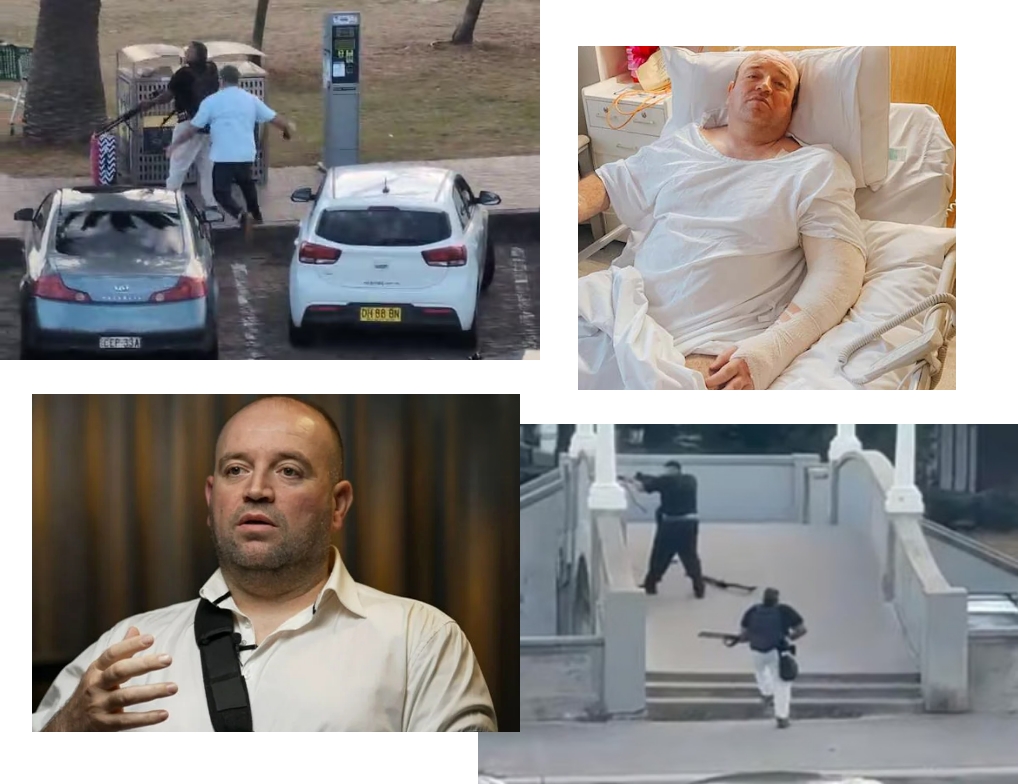
The world has embraced Ahmed. Australia’s prime minister called him an Australian hero. The international Jewish community has recognized in him something ancient and sacred. Zvika Klein, editor-in-chief of the Jerusalem Post, wrote: “Ahmed al-Ahmed belongs in that moral family tree of the ‘Righteous Among the Nations.’” A public GoFundMe campaign has raised more than $1.5 million for his medical needs.
From where do heroes like Ahmed emerge? How do they acquire this remarkable capacity — this presence of mind, this courage, this fierce resolve, this strength — to go so far beyond the instinct for self-preservation?
Do they just happen to be the right match for the moment — well trained in the art of warfare, an expert at de-escalation, or with a masterful killer instinct honed by a sporting discipline?
In the case of our Bondi Beach hero, none of these conditions hold true. So from where did Ahmed’s heroism arise that day?
Here is what he said, in a television interview after the attack.
“I [felt] something, a power in my body, my brain.”
We might wish to ask him…So, Ahmed, where did this power arise from?
“I [didn’t] want to see people killed in front of me, I [didn’t] want to see blood, I [didn’t] want to hear his gun, I [didn’t] want to see people screaming and begging, asking ‘help, help.'”
Yes, nor would we. But, Ahmed, even so, even so… where did you get the courage, the strength, the clarity, to do what you did?
Then the moment arrives in the TV interview where he gives us the answer.
“My soul asked me to do that.”
Oh, wow.
The soul, quite evidently, does not draw lines between one faith and another, between one’s loved ones and strangers.
The interviewer asked Ahmed — once he got hold of the gun, didn’t he want to shoot the gunman who had caused this mayhem?
“I didn’t think to shoot,” Ahmed replied. “I don’t want to put my hand in blood. I don’t think I’m the one who can take [the] life of people.”
After pulling the gun from the terrorist’s hands, Ahmed had carefully laid it down beside a palm tree. Perhaps the same soul that directed him toward the gunfire also directed him away from any act of vengeance, keeping him pure while making him brave.
We may be tempted to search his background for a more rational explanation. Is there in his past some explanation for his extraordinary heroism? Did he attend some special soul-school, or was he raised in a family of saints?
All the accounts I have found of his life suggest he is not much different from you or me — an ordinary human being who left his native Syria nearly twenty years ago to build a quiet life in Australia: a shop, a family, a daily faithfulness to small duties.
But listen to how he speaks. When asked, in the days after the attack, what message he had for the world, Ahmed said: “Feel in love with all humanity, whatever religion. We are a human being.”
This cannot possibly be a philosophy composed after the fact; it has to be the disposition he was already living. A man who walks through his days feeling in love with all humanity is a man whose soul does not have to shout to be heard.
Irena Sendler would have understood him well, for she, too, once walked toward grave danger for the sake of strangers. Irena was a Polish social worker who smuggled some 2,500 Jewish children out of the Warsaw Ghetto in toolboxes and gunny sacks. She deflected all talk of heroism late in her life with a simple explanation: “I only did what my heart commanded.”
Her preparation, she said, was a proverb her father taught her in childhood — that when you see someone drowning, you jump in to save them, whether or not you know how to swim.
A soul commanding a fruit seller in Sydney; a heart commanding a social worker in Warsaw. One voice, wearing two names.
Maybe there’s a lesson in these two stories for you and me.
We do not need to go in with guns blazing to draw out the hero in us. We do not need the bravado of Batman. And we do not need a special school for the soul, because the soul has been enrolled in us from the beginning.
Instead, if you live life with a deep love for humanity, with a desire to step up and serve in whatever conditions are unfolding around you, without looking for the prize or recognition that may come your way, then you start to pay heed to the moment-by-moment counsel of your soul.
Most days, its asks will be small — a kindness here, a truth spoken there, a patience extended when patience is hard.
Then one day it asks you to engage in an act beyond the ordinary, and when it does, you too feel a power in your body, your brain.
The next thing you know, the world is celebrating you as a hero.
But deep inside, you hold a quieter truth: ‘All I did was to keep going where my soul wished to take me.’
Listening alongside you,
Hitendra
Like This Newsletter?
Share it with someone who might find it valuable.


Leave a Reply