
If you’ve been following this series, you know that a group of 18 incarcerated men at Solano Prison had already woven their place into my heart. (If you missed it, you can find Part I and Part II of the series here.)
On the final day of our workshop, they did something I will carry with me for the rest of my life.
But I need to start with a story.
A Lesson in Humility
On Day 2 of our Inner Mastery, Outer Impact workshop, I had been talking with the men about how each of us grows up inside a particular culture, absorbing its norms and assumptions about what is “good” and “normal,” and how this invisible conditioning shapes the way we perceive others. I invited them to resist the urge to judge others, and instead to approach every new person as a window into a world we haven’t yet understood.
To illustrate, I shared a memory from my first days in America.
“In India,” I told them, “it is very common for men to hold hands as they walk together. It is a sign of platonic friendship—of warmth, of affection. I have such fond memories of doing this with my friends growing up.
“When I came to America to go to graduate school, I developed a strong friendship with a fellow student, Peter. Peter and I would sometimes walk across campus, and I would extend my hand to hold his. He would instinctively recoil!”
Laughter rippled through the room.
“I found it really troubling. I thought, What is wrong with Peter? Later, I came to understand that in America, two men do this only if they are gay. So I stopped expecting my friends to hold my hand.”
Everyone was grinning.
The Personal Journeys
It was now the afternoon of Day 3, our final day together.
We had designed this portion of the workshop for each participant to share a personal journey: a moment of reckoning, a turning point, an insight that had reshaped who they were. We had given them a time limit so we could get through all eighteen and still have forty-five minutes for a proper closing session.
The time limit lasted about two stories. What these men began to share was not something you could put a clock against.
Jerry spoke about the night he realized, in his cell, that the person he had harmed most in his life was not the victim of his crime, but himself. Darren described writing a letter to his daughter that took him three years to finish, because every draft forced him to confront a truth he wasn’t yet ready to face. And Andew—one of the quietest men in our group—stood up and, in a voice that barely carried past the first row, described the moment he forgave his father.
One powerful personal journey after another.
With every passing minute, the facilitator in me was getting increasingly worried.
Only forty minutes left for the closing…
We simply had to have enough time for a proper close. After a storytelling session like this, so much gets stirred on the inside. Everyone in the room was in a deeply moved place—the men, my colleagues, me. We needed to create a space where these feelings could be processed, where people could connect with each other, where some form of closure could be achieved. We could not just pack up and rush out of their lives after three profoundly moving days.
And yet, I had an immovable commitment that evening. A meeting in Palo Alto, ninety miles away, that I could not be late for. The clock was not negotiable.
The stories continued. Beautiful, unhurried, necessary.
By the time the last man sat down, I looked at the clock.
Five minutes.
Not forty-five. Five.
The Impossible Close
Any experienced facilitator keeps a few backup plans for how to close gracefully when things go off track. I had several, but none of them would work in five minutes.
How were we going to help people process the feelings these stories had stirred in them? Give people a chance to appreciate each other? Close out with commitments for the six-month journey ahead? Thank people? Say our proper goodbyes to every person in the room?
All of this—in five minutes?
There was no logical solution, so I did what I have learned to do in such moments. I stopped thinking and started listening, to something quieter, something deeper.
I turned off my rational mind and appealed to my intuitive mind.
“Brothers, let us all rise.”
I had no idea what would come next. But getting them on their feet seemed like the right place to start.
My rational mind jumped in. Have them walk around the room appreciating each other! Then, immediately, it challenged that idea. If they do that, they’ll get so deep in conversation that pulling them back in five minutes will feel like a betrayal. And you still haven’t addressed commitments, or goodbyes, or…
I let the voice go.
Something quieter spoke. Get everyone into a circle.
“Let’s clear the tables and chairs to the sides of the room.”
Everyone moved quickly, instinctively, sensing that something was gathering.
We formed a circle. Eighteen men in blue. My colleagues. Me. Standing shoulder to shoulder in a prison, the fluorescent lights humming overhead.
The intuition spoke again. Bring them closer.
That’s when I remembered. The story from yesterday. The one about holding hands in India.
“Brothers,” I said softly, looking across the circle at their faces, faces I had come to know over three extraordinary days. “Let us, in the spirit of all the people across our world’s beautiful and diverse cultures who hold hands to celebrate their soul-connection…”
I extended my hands to the men on either side of me.
“…hold hands around this circle.”
Smiles broke across the room. Every man reached for the hand beside him.
“Look around this circle,” I said. “At all who have been part of these three days.
“When you see them, see their story. See their journey. See their soul.
“Offer them your appreciation for who they are. Your gratitude for what they have brought to our time together. Your prayers for who they are questing to become.”
I paused. The men exchanged nods and glances.
“And even as you give, be open to receiving. Receive the assurance that all your brothers are here for you. They honor your journey. They recognize you for who you truly are at the core of your being. They will cheer you on toward the future you are building, within and around you.”
My voice dropped lower.
“And they will hold you accountable, to the soul-standard that will become the sole standard for how we all wish to live, and love, and lead.”
No one moved. No one needed to. In that silence, I felt something I can only describe as the dissolution of every boundary in the room—between teacher and student, between free and incarcerated, between past and future.
Nietzsche once wrote, Invisible threads are the strongest ties. What I had feared would require forty-five minutes of careful facilitation had been accomplished—collectively, mysteriously—in a single, luminous instant, through an invisible thread.
We unclasped our hands. And then, applause. Handshakes. Embraces. Men who had spent decades behind walls, holding each other without reservation.
One of them found me as the circle dissolved. He put his hand on my shoulder and said quietly,
“This is the closest I have felt to God in a long time.”
There was nothing I could say. I simply nodded and held his gaze.
The Drive
As my colleagues and I walked out of Solano Prison that evening, passing back through the security protocols, back through the heavy doors, back into the November air, I thought of something the mystic Pierre Teilhard de Chardin once wrote. I imagined him whispering:
These men, Hitendra, that you just spent time with. They are not human beings who just had a spiritual experience. They are spiritual beings who have had a human experience.
From Solano, I drove to Palo Alto for my evening meeting, a dinner with an extraordinary couple who have, for years, been deeply devoted to using their wealth to support noble causes in the world.
When I finally entered my hotel room later that night, I sat on the edge of the bed and let the full weight of the day settle over me.
I had spent the day with eighteen men serving life sentences in a state prison. I had spent the evening with two of the most financially successful and philanthropically active people on the planet.
And I had been equally touched, equally inspired, by all of them.
It hardly mattered that eighteen of them possessed little more than their blue jumpsuits, while two of them could buy almost any asset in the world. The soul does not care about your address. It only cares whether you are doing the work.
This three-part journey began with a question. What inner prison might be holding you captive?
Then, it moved through a deeper one. What is your pain trying to teach you?
And now, it ends here, with the simplest question of all.
Who are you, when every wall comes down?
Who are you at the center of the circle, with your hands open, ready to hold and be held?
The men at Solano showed me their answer. In one minute of silence, holding hands in a prison recreation room, they showed me more about the human soul than most people encounter in a lifetime.
The monastery is wherever you choose to build it. The circle is wherever you choose to form it. And the work—the beautiful, difficult, victorious work of sculpting the statue within—is available to you right now.
Wherever you are.
In solidarity,
Hitendra
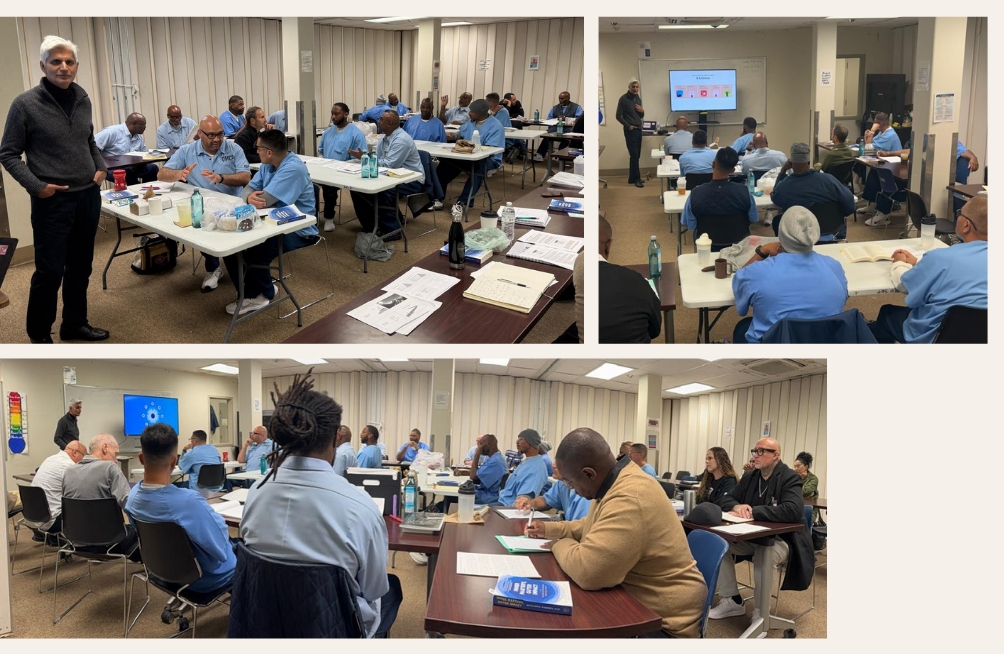
P.S. The circle we formed in that room at Solano—eighteen men in blue, hands clasped, walls down—represents the same work we’ll be doing this June at the Omega Institute in Rhinebeck, New York. For three days together, June 12–14, we’ll activate the Five Core Energies within us, break out of our limiting mindsets, and learn to lead with authenticity and purpose, no matter what it is we’re leading—a team, an organization, our own lives.
The monastery is wherever we choose to build it. If reading this series has stirred something in you, this is your invitation to go deeper. Register on the Omega Institute website.
Like This Newsletter?
Share it with someone who might find it valuable.


Leave a Reply