
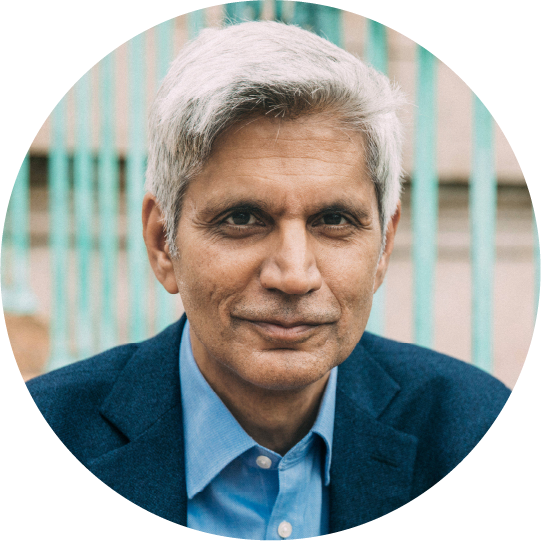
In my book, Inner Mastery, Outer Impact, I reflect on how “many of us struggle to balance the drumroll of the world with the beat of our own heart.”
The George Harrison story I am going to share today is a beautiful example of bucking societal norms to express your greatest truth — and doing so in such a thoughtful way that you captivate the world.
During his time with the Beatles, Harrison was in the company of John Lennon and Paul McCartney, two highly prolific songwriters. Lennon and McCartney did not think too highly of Harrison’s compositions. This put a lid on Harrison’s output as a songwriter, since the Beatles would only accommodate one or two of Harrison’s compositions on any new album. And yet, from his time with the Beatles came Harrison’s classics, “While My Guitar Gently Sleeps,” “Something,” and “Here Comes the Sun.”
In the years after the Beatles disbanded, the floodgates opened, culminating in Harrison’s release of a three-record collection, All Things Must Pass. This album featured a rather peculiar love song.
It was a love song to the Creator: “My Sweet Lord.”
“My Sweet Lord” was inspired by “Oh Happy Day,” a two hundred-year-old gospel tune rearranged into a popular song for the Edwin Hawkins Singers. Harrison reflected, “It really just knocked me out… I just felt a great feeling of the Lord. So I thought: ‘I’ll write another ‘Oh Happy Day,’ which became ‘My Sweet Lord.’”
“At that time,” Harrison later recounted, “nobody was committed to that type of music in the pop world. There was, I felt, a real need for that. So rather than sitting and waiting for somebody else, I decided to do it myself. A lot of times, we think, ‘Well, I agree with you, but I’m not going to actually stand up and be counted — too risky.’ Everybody is always trying to keep themselves covered, stay commercial. So I thought, ‘Just do it.’ Nobody else is…”
Harrison took a big commercial risk with this song. “I thought a lot about whether to do it or not, because I would be committing myself publicly and I anticipated that a lot of people might get weird about it.”
“I was sticking my neck out on the chopping block,” he wrote in his autobiography, I Me Mine.
One music critic judged “My Sweet Lord” to be “among the boldest steps in the history of popular music,” and quite possibly “a fatal career move.” The critic wrote, “The boldness was the naked emotion of George’s surrender to God. The gamble was whether fans would still accept him after realizing the depth of his devotion.”
And the result?
Within a month of its release, the album All Things Must Pass climbed to the number-one spot in America. “Of all the Beatles’ solo albums to date,” wrote the Times of London, “All Things Must Pass makes far and away the best listening. Harrison’s light has been hidden under the egos of McCartney and Lennon, but from time to time there have been hints on several of their albums that he was more than he was allowed to be.” All Things Must Pass became the bestselling album by an ex-Beatle.
“My Sweet Lord” became the No. 1 single in America, and an international megahit. Elton John first heard “My Sweet Lord” while riding in a taxi. “My God!” he thought, and broke out in chills. John Lennon shared, “Every time I put the radio on, it’s ‘Oh, My Lord.’ I’m beginning to think there must be a God.”
Your hungers might be humanity’s hungers, too.
By going deep down to express the yearning of his soul, Harrison connected to the latent hunger of so many silent listeners who had longed for a similar outlet. One writer reported, “Once the record made it to radio, letters addressed to George Harrison started pouring into the London temple from all parts of the world. It seemed a lot of people had been waiting for someone to validate their own search for God, and from the day the record was released, thank you letters started coming and never stopped.”
“I still get letters from people,” Harrison said in the 1980s, “so I know by the Lord’s grace I am a small part in the cosmic play.”
I discovered this song as a teenager in the 1980s growing up in Chandigarh, India, and it swept me off my feet. In those years, I had two relationships with music. There were my material moments, of being immersed in pop music, of connecting with the youthful yearnings of my generation. And then there were my transcendent moments, of being engaged in devotional chanting, of connecting with life, nature, the universe, and the creative spirit behind it all.
“My Sweet Lord” allowed me to fuse both parts of my life, the material and the spiritual. Harrison’s guitar gently wept as he chanted the song’s lyrics, his voice conveying a deep spiritual hunger to know God.
My sweet Lord
My Lord
Mmm, my Lord
I really want to see you
Really want to be with you
Really want to see you, Lord
But it takes so long, my Lord
What prompted Harrison to bare his soul like this?
“I don’t want to die as ‘George Harrison record producer’ or ‘George Harrison lead guitarist’ or even just a Beatle,” Harrison told New Musical Express in March 1970. “They’re all me — but they’re not really me. The moment people start typecasting, then it’s time to move on. I’m unlimited. We’re all unlimited.”
When asked about his future ambitions, Harrison said, “I want to be God-conscious. That’s really my only ambition, and everything else in life is incidental.” His widow, Olivia, has reflected that he “transcended the distractions of success and fame to maintain a one-pointed focus upon his goal of spiritual awakening.”
But the song was more than a call to faith.
“My Sweet Lord” was also a way to dissolve barriers between faiths.
Raised Catholic, Harrison became interested in Hinduism in the mid-60s. Through meditation, Harrison began to delve deeper into Eastern spiritual ideas. One of those was monism — the idea that there is one underlying Spirit in creation, one universal being, and all of us are drops in that larger ocean. The purpose of life is to awaken to this eternal connection between us and the divine. This delving led him to discover the life and teachings of one of India’s spiritual luminaries, Krishna.
“I always felt at home with Krishna. You see it was already a part of me. I think it’s something that’s been with me from my previous birth. I’d rather be one of the devotees of God than one of the straight, so-called sane or normal people who just don’t understand that man is a spiritual being, that he has a soul,” Harrison said.
Deepak Chopra has reflected, “When [Harrison] would engage in conversation it was all about spirituality. He was a very, very avid reader and not just an avid reader of Eastern spirituality, but a very avid reader of the Gnostic gospels, the other versions of the historical Christ, the Gospel of Thomas. When he signed a letter he would always put an eastern symbol and also put a cross. He very much had a relationship with Christ… all along. He had a very personal relationship with Christ.”
In “My Sweet Lord,” George went about trying to dissolve the boundary between Christianity and Hinduism. He shared in an interview in 1982, “I wanted to show that ‘Hallelujah’ and ‘Hare Krishna’ are quite the same thing.” So, he wrote a choral line in “My Sweet Lord: using the word “Hallelujah” as the refrain — then switched midway through the song to the phrase “Hare Krishna.”
“I did the voices singing ‘Hallelujah’ and then the change to ‘Hare Krishna’ so that people would be chanting the maha-mantra before they knew what was going on.” The song was meant to be “a Western pop equivalent of a mantra, which repeats over and over again the holy names.” His purpose was not to proselytize, but to celebrate the universal, cross-faith yearning in people for transcendence.
By producing “My Sweet Lord,” Harrison took a bold and beautiful step.
He once reflected, “I believe in the thing I read years ago in the Bible. It said, ‘Knock and the door will be opened.’ And it’s true. If you want to know anything in this life, you just have to knock on the door.”
“I’ll tell you one thing for sure, once you get to the point where you’re actually doing things for truth’s sake, then nobody can ever touch you again, because you’re harmonizing with a greater power.”
There are five lessons we can draw from this story.
#1: Be careful not to let the smart, successful people in your tribe suppress the unique spark possessed by the shyer, quieter ones.
#2: Open yourself up to your deepest yearnings. If you find there’s a real unmet need out there, don’t sit and wait for somebody else — just do something about it yourself.
#3: Merge the material with the spiritual. They don’t have to be separate things in life; they are meant to be one.
#4: When you want to open people up to a deeper understanding, first meet them where they are, relate to them, then gently hold their hand and walk them across the bridge to the truth you wish to reveal.
And this fifth lesson may be the most magical of all.
#5: Do things “for truth’s sake” — “then nobody can ever touch you again, because you’re harmonizing with a greater power.”
And that is my wish for you this holiday season, and for the new year ahead — that you do things for truth’s sake, and find yourself harmonizing with a greater power.
Warmly,
Hitendra
“Each soul is potentially divine. The goal is to manifest the divinity…Every one of us has within us a drop of that ocean and we have the same qualities as God, just like a drop of the ocean has the same qualities as the whole ocean. Everybody’s looking for something and we are it. We don’t have to look anywhere – it’s right there within ourselves.” George Harrison
Like This Newsletter?
Share it with someone who might find it valuable.


Leave a Reply