
If you read Part I of this series, you know that on a crisp November morning, I walked into Solano Prison and discovered something special: a room full of men ready to turn their confinement into a cathedral of inner transformation.
A few weeks later, we went back.
This time, we weren’t just visiting. We were diving into the deep.
Our plan was ambitious. In partnership with our friends at CROP, we were launching a three-day intensive workshop on Inner Mastery, Outer Impact with the cohort of eighteen incarcerated men, to be followed by a six-month journey of daily practice, weekly meetings, and peer-to-peer support.
As my team and I walked down the corridor toward our workshop room, something stopped me.
On the wall was a whiteboard. The prison community had filled it with a collection of handwritten quotes—lines from thinkers, poets, spiritual teachers. Some were written carefully, almost reverently. Others were scrawled in haste, as though the person couldn’t get the words out of their heart and onto the board fast enough.
I stood there for a moment, taking it in.
It was a subtle but unmistakable sign of something I have come to believe with every fiber of my being: every human being hungers to live an inspired life. Every single one, regardless of where they sleep at night.
The Warning
Day 1 went well. The group was all in. What a gift that is for a teacher.
That evening, the CROP and Mentora staff came together to plan Day 2. The conversation turned to something that had been simmering all day: the pain these men carried.
“Let’s be watchful,” a member of our team said. “Many of these men have suffered enormous trauma growing up. Some were abandoned by their mothers. Some were beaten by their fathers. Some were exposed to gang violence before they were old enough to understand what was happening to them. When we bring up topics like adversity or emotions, when we ask them to discuss their life experiences, some of them will get triggered.”
People nodded. It seemed a bit cruel to invite people to do things that may cause old wounds to open up.
And yet, something was not ringing true for me. I did not know what to say, but I wanted to push back. So I went into my soul and spoke whatever flowed from there.
“These eighteen men. My understanding is that they had to apply to be part of this, so they were screened. We are not working with the mentally ill, which is important, because we do not have that expertise. For these men, then, let me offer this.
“We are not here to sympathize with them.”
There was a startled look on some faces.
“We are here to uplift them, to strengthen them. And that is what we will do if trauma is triggered.”
That night, alone in my hotel room, I thought carefully about how we would handle a trigger moment.
Five Minutes In
The next morning, we started our session on Emotional Mastery. We had barely made it five minutes when one of the men spoke up.
“Hitendra.”
His voice was steady, but I could hear something heavy underneath it.
“You’re asking us today to work on the things that rouse our emotions. That make us depressed, angry, or hopeless. This is going to stir up some heavy stuff.” He paused. “Some of us are holding a lot of pain within us.”
Several heads nodded around the room. The air shifted. I could feel the group holding its breath.
I leaned in.
“Thank you for sharing that. I recognize that pain from the past will get stirred up for some of you today.”
I let a beat pass.
“I am OK with that, and you will be OK with it as well, as long as you are open to building a new relationship with pain.”
The room was very still.
“From time to time, life brings us pain. Everyone has to go through it. Even those who have the most comfortable of lives are ultimately confronted with the struggles of old age, disease and death.
“So it’s not about learning to hide from your pain. It’s about learning to do something meaningful with it. Because in pain, there are possibilities.”
The Hammer of the Gods
“What do you mean?” two of them asked, almost in unison.
I answered, “We live in a culture that assumes pain means suffering. At one level, that is true. But there is another dimension to pain that most people never discover.
“Think about it. Most of the time, we lack the drive to work hard on the things that truly matter to us. We lack courage. We get distracted. We lose focus on our goals. But when we are in pain, real pain, all of those struggles fall away. We are so naturally, effortlessly, completely focused. We feel an enormous motivation to resolve it. It is as though pain is giving us free energy, and the ability to become laser-sharp in our focus.
“Pain, then, can be a real opportunity. To do something powerful. Perhaps to transform yourself. Or your life conditions. Or the world.”
I watched their faces. Some skeptical, some intrigued, all listening.
“A wise teacher from India, Sri Aurobindo, once said, Pain is the hammer of the Gods to break the dull resistance of the human heart.
“Pain can be our greatest teacher. So when it comes up for you, and it will, I want you to ask yourself: What is it trying to teach me? What have I been resisting? How can this pain change me for the better? How can I channel it to make positive change in the world?“
I could see the shift beginning. So I gave them a story.
The Horse Whisperer
“Have any of you heard of a man named Buck Brannaman?”
Blank faces. They hadn’t.
“He’s a cowboy, a horse trainer. Buck is remarkable. He has an almost mystical ability to get horses to trust him, to open up even the most rebellious stallions to his training. Ranchers come to him from all around the country, bringing the one horse they cannot reach. A fiction writer wrote a book inspired by his story called The Horse Whisperer, which Robert Redford made into a film. They also made a documentary about him, simply called Buck, which was nominated for an Academy Award.
“He’s quite something.”
Their curiosity was pulling them forward.
“Buck believes that horses have been profoundly wronged in America: trained through pain, beaten into obedience until they instinctively submit to their ‘master.’ Buck teaches ranchers a different way. He believes horses have a natural affinity for humans. They are wired to be our friends. Once a horse starts to trust you, once it feels genuinely loved by you, it reciprocates. It will now be open to doing anything for you. And when you sit in the saddle, the boundary between you and the horse begins to dissolve. You and the horse become one.
“That’s how you train a horse. Not through domination. Through love.”
I paused.
“That’s Buck’s purpose. He spends most of his year traveling away from his family, going from state to state across America, changing how people relate to their horses. It’s his life’s work.
“You may ask, how did Buck arrive at this radiant purpose?”
The room was silent. Waiting.
“Buck had a devastating childhood. His mother died early. His father was an alcoholic who beat him and his younger brother regularly. Until one day, fearing for their lives, the two little boys escaped. They were raised after that by foster parents.
“Buck went through pain. Deep, searing trauma. He says it is because he went through so much pain that he cannot bear for anyone else to go through it. Not even horses. He has channeled that pain into fuel for everything he does.”
I looked around the room.
“Now, imagine a different version of Buck. Imagine he had come to you as a friend, and said, It is because I went through so much pain that I’m an alcoholic. That I can’t hold a relationship together. That I’m depressed.
“You would have embraced him. You would have said, I understand, brother. I won’t judge you. I feel terrible about all you have had to go through.
“And that would have been the right thing to do. Because who wouldn’t feel deep compassion for someone who has faced such a struggle?”
I paused.
“And yet, this Buck made a different choice. The pain is there. The past is what it is. He chose to use his pain to propel himself—and the world—to a different place. Because he did not want his sad circumstances to write the story of his life.
“He wanted to wield the pen and write it himself.”
The room was charged.
“So for some of you, too, the pain will be there. The past is what it is. The question is: What choice will you make in what you do with this pain, this past, for yourself, and for the world?”
The Victorious Life
I let the silence breathe for a moment. Then, I continued.
“A mystic teacher, Yogananda, once said,
“A smooth life is not a victorious life.
“A smooth life is not a victorious life,” I repeated.
Some men nodded. Some wrinkled their brow.
“Most people, if you ask them what they want, will say they want a smooth life. Get up in the morning. Get dressed. Eat breakfast. Have a great day at work. Come home. Watch Netflix. Go to bed. Next day, same thing. Dress up, eat breakfast, great day at work, lovely meal with family, go to bed. And do this again and again and again, until one day you grow old, you retire, you die.”
A few of them smiled.
“That’s a smooth life. And there’s nothing wrong with wanting that.
“But is it a victorious life?
“Wouldn’t a victorious life have some suspense? Some struggle? Some pain? Some hard work? Some humbling of one’s ego? Some hitting against a wall, and then… some form of transformation?”
Now everyone was nodding.
From there on, we coasted through our session on emotional mastery, on growing from adversity, without a single concern about the pain that was surfacing. Not because the pain wasn’t there, for it was. You could see it in their eyes, hear it in the cracks in their voices when they shared.
But the men were no longer entrapped by it.
They were on a hunt. A hunt for the purpose and possibility hidden inside their pain. Every story they told, every memory that surfaced, was now being examined not as evidence of what had been done to them, but as raw material for who they were becoming. The energy in the room was extraordinary: focused, tender, electric.
The Whiteboard
The next morning, I returned for our final day together. As I walked down the corridor, my eyes went instinctively to the whiteboard—the one that had moved me so much on Day 1.
Something was different.
There, at the very center of the board in fresh ink, written in large, deliberate letters so no one could miss it, was a new quote.
“A smooth life is not a victorious life.” — Yogananda
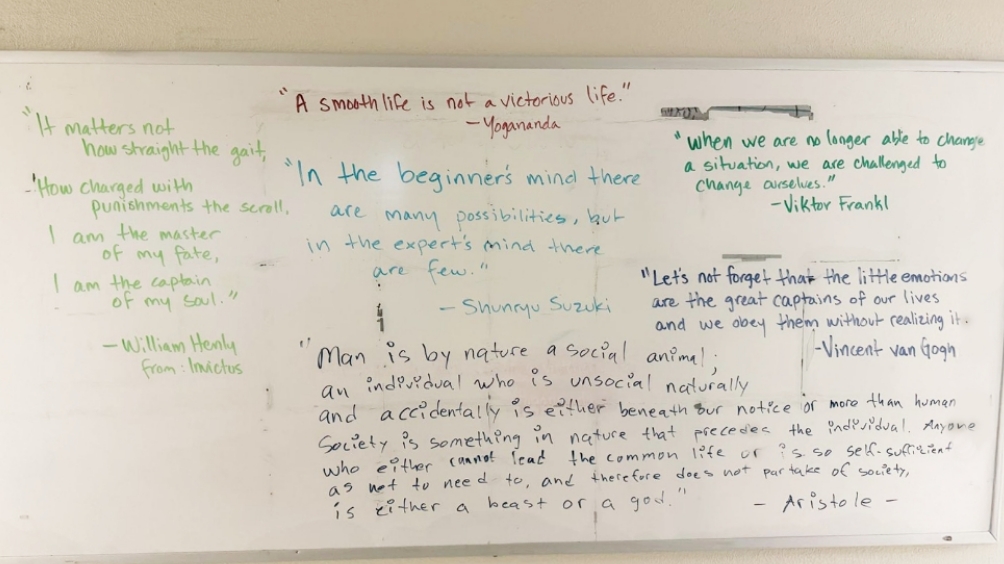
I stood in the corridor alone, staring and smiling at those words.
And I thought, Their journey has begun.
Is there a pain you are carrying? What would change if you started treating it as fuel for the person you are meant to become?
A smooth life is not a victorious life. And the pen that will script your life story is in your hand.
In solidarity,
Hitendra
P.S. A dear friend, after reading Prison Diaries Part I, shared the following story with me about Sri Aurobindo, whom I quoted above.
For his part in India’s freedom movement against British Rule, Sri Aurobindo was imprisoned by the British Government in 1908 for one year. Part of this time was in solitary confinement.
It was during this period that he deepened his inner work of returning to his soul, making significant progress in his practice of yoga and his relationship with the Divine. Prison became, for him, a monastery. He later wrote about that year in prison, “The British Government’s wrath had but one significant outcome: I found God.”
Like This Newsletter?
Share it with someone who might find it valuable.


Leave a Reply